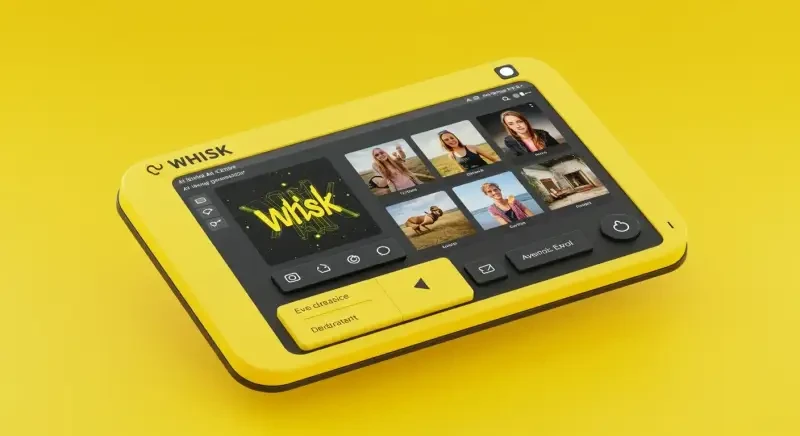
How Whisk AI Is Changing AI Image Generation for Everyday Users
The world of AI image generation has been rapidly evolving, with capable tools becoming increasingly accessible to the public. However, there's always been a significant barrier to entry: the art of writing effective prompts. Google Labs' experimental tool, Whisk AI, is changing that by making prompt engineering easier and putting high-quality image generation within everyone's reach, regardless of technical expertise.
Bridging the Knowledge GapUntil now, getting the best results from text-to-image tools required specialized prompt engineering knowledge. Experienced users have developed complex formulas, specific terminology, and structural approaches that dramatically improve output quality. Whisk AI analyzes simple, natural language descriptions and automatically turns them into more sophisticated, effective prompts.
"We noticed that there was this growing divide between casual users and power users when it came to AI image generation," explains the team behind it. "Our goal is to essentially encode that expert knowledge into a system that can be used by anyone."
This matters more than you might think. Most people who try AI image generators for the first time end up frustrated because their results don't match what they've seen online. The difference almost always comes down to prompt quality and that's exactly the gap this tool fills.
The Technology Behind ItAt its core, it uses a sophisticated natural language processing system built on Google's Gemini AI model, trained on thousands of successful prompts. Whisk AI identifies key elements in a user's basic description: subject matter, intended style, mood, composition, and contextual elements. It then expands these components with specific, technically effective terminology and structure.
For example, when a user inputs "sunset beach scene," Whisk AI might turn this into "golden hour at a tropical beach, dramatic cumulonimbus clouds, warm amber light reflecting on gentle waves, highly detailed digital painting, cinematic composition." The improved prompt contains specific lighting details, atmospheric elements, and stylistic descriptors that dramatically improve the output quality.
What makes this approach different from simply using a template is that Whisk AI actually understands context. It knows that a "cozy cabin" needs warm lighting and soft textures, while a "futuristic cityscape" calls for neon colors and sharp angles. This contextual awareness is what separates it from basic prompt generators.
Real-World ImpactThe impact is being felt across multiple sectors, from individual creatives to small businesses and educational institutions:
- Independent creators are using it to generate concept art, storyboards, and illustrations without needing to master complex prompt techniques.
- Small businesses are creating professional-grade marketing visuals, product mockups, and brand assets without specialized design knowledge.
- Educators are bringing AI image generation into their curriculum, with Whisk AI helping students overcome the initial learning curve.
- Content creators are producing custom thumbnails, social media graphics, and blog illustrations in minutes instead of hours.
There are plenty of real examples in the style showcase gallery.
According to research published by Cornell University on text-to-image generation, the gap between expert and novice prompt results remains one of the biggest challenges in generative AI adoption. Tools like this directly address the problem by encoding expert knowledge into an accessible interface.
Limitations to Keep in MindNo tool is perfect, and Whisk AI, and there are a few things to be aware of. The prompt improvement works best with English-language descriptions. Very abstract or conceptual ideas like "the feeling of nostalgia" can still be tricky for any AI to interpret. And while the results are consistently good, they won't always match what a skilled prompt engineer can produce with careful manual tuning.
That said, for the vast majority of use cases, the output quality is more than sufficient. Most users report that the automatically improved prompts give them results that are 80-90% as good as what an expert would produce and they get there in seconds rather than minutes of trial and error.
What This Means for the Future of Image CreationThe bigger picture here is about accessibility. Two years ago, creating a high-quality AI-generated image required 15-20 minutes of prompt tweaking. Today, you can get comparable results in under a minute. That speed difference isn't just convenient it changes who can use these tools and what they can be used for. Small business owners, teachers, hobbyists, and social media managers can now produce professional-looking visuals without hiring a designer or learning a new skill. That's a meaningful shift in who has access to visual creation tools.
Update (April 2026): Google has since announced Whisk AI will shut down on April 30, 2026. Here's what to use instead.
As this Google Labs experiment continues to evolve, the team is carefully monitoring user feedback and iterating on Whisk AI. Ready to start creating? The beginner's guide is a good place to jump in.